Showing posts with label Rasulullah salallahu alayhi wa salam. Show all posts

Monday, 19 December 2011

The Sinister...'Far Away, Distant' Feeling

That ‘far away, distant' feeling is something that comes to us all every now and then. This is that feeling, where everything feels blurred and everything seems distant. It seems that everybody is getting on with something or the other and you seem to be standing still; it just feels that you are stuck in a time and place from which you can’t get out of! An example of this to a lower degree can be seen in a student who is sitting in an exam hall; he sees everybody around him doing something but his brain feels to blunt to think of something and his stomach begins to churn as he sees his time is running out.

The reality of this all is that different incidents in a person’s life can trigger of this feeling. Sometimes, an abundance of work and pressure could be the cause; at other stages panic and anxiety could be a reason. Sometimes desperation could settle into oneself and many times, all these factors come together to hit insaan for a six! He then becomes like that cricket ball which has been hit out of the stadium and is sitting outside in the car park all by itself, waiting for somebody to pick it up and bring it back to its rightful place (i.e. the pitch). Similarly, when life is moving so fast around us and we feel completely dazed, we too need someone to take us by the hand and put our hearts’ at ease.

This feeling is an emotion that comes to us regularly and perhaps more so as we grow up and less so as we reach an elderly age. As a person grows, his responsibilities increase and he finds himself juggling between those actions which he must do (whether he likes it or not) and those actions which he likes to do (as a hobby). During his life, he will find himself constantly balancing between the two. When a person starts taking too much on, he finds himself bewildered at the sheer pace of life. There seems to be too many things happening and too little time to analyse them all.

In some instances, an issue of great magnitude such as a person’s death is placed in front of us which totally sweeps our feet from beneath us. Another example could be of a person who is planning to get married; he may be preparing for months on end but as the time to tie the knot approaches, he begins to feel that there are many things which he hasn’t dealt with! In both situations, a person is left befuddled and perplexed.

And in some instances, a person can want to feel far away from everything! When a person constantly sees ‘snakes’ from amongst his dear ones and dark evil in his surroundings, one naturally wants to curl up into a ball and stay in one corner. Sometimes sadness comes to us in abundance and the only reprieve seems to be in the darkness of a silent room. Thus, the far away feeling occurs because a person doesn’t want to feel close to the action.

Finally, you have others who experience the far away feeling because they are quite simply potty! This is when a person is just to foolish to do what is good for himself and continues doing stupid things which prove to be a hindrance to his existence! An example I hear you say? Take the example of a person who wastes his life in a shisha cafe; everyday he wakes up, he does the same thing. He brushes his teeth, wears his jacket, takes money from his parents and follows his friends (who may also be potty) into a shisha cafe. He thereafter wastes pound after pound in buying drinks, coals, snacks etc. The most bizarre thing of all is that this very same person has a career defining exam the following day and he should be revising! As a result, he sits in the exam hall the next day and all he can do is squirm in his chair when he sees his classmates around him pencilling in their exam papers at speed.

So how can a person stop this feeling or get out of it? There are a variety of things he can do. Below are just a few:

  • Stop feeling sorry for yourself – sometimes a person needs to slap himself (not literally) and pull his socks up. For how long will a person feel sorry about himself and watch the people around him be successful and not be a part of that success himself? A person must produce unyielding efforts to break away from the vicious cycle of self pity and sorrow.

  • Grab hold of a good friend to help you – sometimes we can’t see how deep we are in a situation. At times we exaggerate our problems and at other times, we play matters which are of huge relevance down. When we have the ‘far away feeling’ we should confide this matter in a close, loving, knowledgeable friend. We should explain to him, “I need you to help me pick myself up and make use of my time.” This feeling can bring much sadness to a person which in turn brings a fatigued, lazy ethos. We need to tell our close friend, “When you see me wasting my life away, pull me together and slap me (literally)!”

  • Get up and go – have some ‘get up and go’ about yourself. You may find that nobody can help you; that should not send you into a murky abyss. Rather, fortify your intentions and make something of yourself.

  • Take the advices from the Qur’an and the Hadith - While the Qur’an cheers up a saddened soul, it also has great advices to push a person in the right direction. Similarly, the words of our Nabi salallahu alayhi wasallam have great blessings; he himself would say, ‘I am a source of peace for my companions’. Thus, if we engross ourselves by becoming his companions (i.e. by studying his words), his invigorating shadow will extend over us also.

  • Make lots of dua – only Allah Ta’ala is the One who can take us out of the darkness we see before us. Allah Ta’ala says in the Qur’an, “When My servants ask you about Me, then (tell them that) I am near. I respond to the call of one when he prays to Me; so they should respond to Me, and have faith in Me, so that they may be on the right path.” The court of Allah Ta’ala isn’t like a shop which has opening and closing hours; it is open all hours. The court of Allah Ta’ala is like that shop which has everything a person could need and more; he just needs to pre-order through his dua and Allah Ta’ala will send him what he requires. The postage, packaging and delivery depends on that person’s sincerity in his dua but when does eventually receives it, five star customer satisfaction is guaranteed!

May Allah Ta’ala grant us all aafiyat and make our hardships easy for us. Ameen, ya Rabbal ‘Aalameen.

Tuesday, 27 September 2011

Being Gentle...like a butterfly

The idea of being a stoned face, mysterious individual with a sense of firmness sounds appealing to some; when this type of character exudes from a person, a sense of dominance can emanate from within the heart. This eventually leads one to become ill mannered and arrogant which in turn changes a person into a prideful being. As a result, this firmness which seemed to be awe inspiring has now taken a person to the banks of Jahannam. It is for this reason that Rasulullah salallahu alayhi wasallam said, "Harshness does not exist in something except that it makes it repulsive. Indeed Allah is compassionate and He love compassion.”


Unfortunately, we live in very rough society; such an environment has almost nurtured us to be hostile naturally. I understood this perfectly when I recently went to Madinah. I had left the hotel to go to the Prophet’s salallahu alayhi wasallam Mosque for Iftar when a brother suddenly grabbed my arm 20 meters away from the mosque. I instantly took him to be a trouble maker but I soon realised he was actually calling me to sit and break my fast with him. I watched him and found his courteous behaviour to be ever so pleasant. I then began to question myself as to why I had been so firm with him. I realised that it was the society that I had come from which told me to be defensive and sceptical as opposed to being gentle and friendly.

The sunnah or Rasulullah salallahu alayhi wasallam teaches us differently. It teaches us to be gentle and soft to every living and lifeless thing. During the battle of Uhud, Rasulullah salallahu alayhi wasallam commanded the archers to remain on a hill close to the battle until the war was won. Due to a misunderstanding, they left their positions which resulted in the death of 70 companions. However, Rasulullah salallahu alayhi wasallam was not harsh to them, nor was he aggressive. Rather, he was understanding and sympathetic; he accepted their reasons and pardoned them. He himself states in one hadith, “Forgive right-acting people for their mistakes.” Such behaviour brought about the pleasure of Allah Ta’ala and He notably mentions in the Qur’an,

“It was a mercy of Allah that you were soft and gentle with them. If you were rude, harsh, hard hearted, then they would have fled away from you. Pardon them, seek forgiveness from Allah for them and in future, consult them in the matter”

Softness is truly a characteristic which we must inculcate into our life. However, this does not mean that we become naive. If we live in such a place where there is much trickery and deceit, then it is not an act of piety to be forbearing. On the other hand, this is foolishness as a person is asking to be hoaxed.

Being gentle should be within us naturally. When a person is gentle, it beautifies him as a person and also wins the heart of people. Rasulullah salalallahu alayhi wasallam said, “Softness does not exist in anything except that it beautifies it.” However, in order to bring this characteristic within ourselves, we must aim to become tolerant. A person can only learn to forgive and be soft to others once he has subdued his nafs to such an extent that he does not become angry at petty things. When a person is able to blow away his annoyance, signs of compassion may then prevail in him.

Showing kindness to animals is enough for Allah Ta’ala to forgive a person. Imam Bukhari rahimahullah relates a narration in which a person fed a thirsty, ailing dog water which cured him. As a result, Allah Ta’ala forgave his sins. On the other hand, the hadith that Imam Bukhari rahimahullah brings thereafter shows the state of a woman who treated her pet so poorly that it was completely malnourished. As a result of her hard heartedness, Allah Ta’ala entered her into the fire. If this is the case with regards to animals, then what can be said for humans and especially our Muslim brothers and sisters?

There are some misinformed people who try to use Hadhrat Umar radiallahu anhu as their justification to being harsh. Such people quite simply do not know who Hadhrat Umar radiallahu anhu was. He was a soft, loving, caring man who shed tears for the sake of this Ummah. Such people who claim that he was harsh and stern know very little of him. His firmness was to those who had disobeyed Allah Ta’ala and caused pain to the Muslimeen but besides that, he was merciful to the believers as well as the non believers. Many narrations can be put forth of his softness. Let it be remembered, that he was a person about whom people used to say prior to his acceptance of Islam, “There is more chance of Umar’s donkey accepting Islam!” However, his heart was thereafter nurtured by the one who has been titled as the Mercy to Mankind; surely then, such characteristics would have been found in him also. Finally, I conclude with the hadith:

"Whoever has been given his portion of compassion has been given his portion of good. Whoever is denied being given his portion of compassion has been denied his portion of good. Good character will be the weightiest thing in the believer's balance on the Day of Rising. Allah hates a coarse, foul-mouthed person."

May Allah Ta'ala bless us with such characteristics. Ameen.

Thursday, 28 July 2011

Commentary on Hadith: How Rasulullah salallahu alayhi wasallam received revelation - part 3

Following on from the first post which can be viewed here, and the second post which can be viewed here we continue with the commentary of the third hadith of Bukhari sharif which describes the manner in which Rasulullah salallahu alayhi wasallam received Revelation.

فَجَاءَهُ المَلَكُ فَقَالَ: اقْرَأْ، قَالَ: " مَا أَنَا بِقَارِئٍ "، قَالَ: " فَأَخَذَنِي فَغَطَّنِي حَتَّى بَلَغَ مِنِّي الجَهْدَ ثُمَّ أَرْسَلَنِي، فَقَالَ: اقْرَأْ، قُلْتُ: مَا أَنَا بِقَارِئٍ، فَأَخَذَنِي فَغَطَّنِي الثَّانِيَةَ حَتَّى بَلَغَ مِنِّي الجَهْدَ ثُمَّ أَرْسَلَنِي، فَقَالَ: اقْرَأْ، فَقُلْتُ: مَا أَنَا بِقَارِئٍ، فَأَخَذَنِي فَغَطَّنِي الثَّالِثَةَ ثُمَّ أَرْسَلَنِي، فَقَالَ: { اقْرَأْ بِاسْمِ رَبِّكَ الَّذِي خَلَقَ . خَلَقَ الإِنْسَانَ مِنْ عَلَقٍ . اقْرَأْ وَرَبُّكَ الأَكْرَمُ } ،

“And then an angel came to him and said, ‘Read!’ Rasulullah salallahu alayhi wasallam replied, ‘I am not one who can read!’ Rasulullah salallahu alayhi wasallam said, “The angel then grabbed hold of me and squeezed me until I felt that I was going to become unconscious, he then released me and said, ‘Read!’ I replied, ‘I am not one who can read!’ The angel then grabbed hold of me again and squeezed me until I felt that I was going to become unconscious, he then released me and said, ‘Read!’ I replied, ‘I am not one who can read!’ The angel then grabbed hold of me and squeezed me a third time until I felt that I was going to become unconscious, he then released me and said, ‘Read!’ I replied, ‘I am not one who can read!’ Then he said, ‘Read with the name of your Lord who created (everything); He created man from a clot of blood, Read! And your Lord is Most Gracious.’”

Commentary

“And then an angel came to him” – A question which arises here is that how did Rasulullah salallahu alayhi wasallam know that he was conversing with an angel?

Answer 1: Imam Isma’eely rahimahullah states that Rasulullah salallahu alayhi wasallam was not aware that he was conversing with an angel at the time but as they continued to meet, Rasulullah salallahu alayhi wasallam understood that it was an angel he spoke too . This is why when Rasulullah salallahu alayhi wasallam spoke about this incident at a later time, he used the term ‘angel’.

Answer 2: Sirajud Deen Balqeeni relates that it is possible that Rasulullah salallahu alayhi wasallam remembered the incident that occurred in his childhood (i.e. when the angels opened his chest and cleansed his heart). However, this answer is not weighty as we still don’t know how Rasulullah salallahu alayhi wasallam knew his heart was being cleansed by angels in his childhood.

Answer 3: Aishah radiallahu anha is the narrator of this hadith and it is possible that she used the term ‘angel’ to describe what had happened. (Fathul Baari)

Out of all these explanations, the first answer is the best. (Kashful Baari). This angel was Hazrat Jibraeel alayhissalaam.

When did the angel come, what was the month and how old was Rasulullah salallahu alayhi wasallam at that time?

It is an agreed matter that Rasulullah salallahu alayhi wasallam received the revelation on a Monday. However, there are three opinions in relation to the month in which it happened. 1) The famous opinion is that it happened in the month of Rabee’ ul Awwal either on the 1st or 8th day (2) 2nd of Rajab (3) This happened in Ramadhan. There is a difference of opinion in relation to the actual date; 7th, 17th, 24th have all been mentioned.

Hafiz ibn Hajr al Asqalani rahimahullah says that the third opinion is the most accepted opinion as Rasulullah salallahu alayhi wasallam would be doing I’tikaf during this time.

There has been some discussion with regards to the age of Rasulullah salallahu alayhi wasallam. It is quite famous that Rasulullah salallahu alayhi wasallam was 40 when he received revelation for the first time however there are many opinions in what his exact age was. From amongst them are: (1) 40 yrs and 10 days (2) 40 yrs and 40 days (3) 40 yrs and 2 months (4) 42 yrs (5) 43yrs (6) 45 yrs.

The most accepted opinion here is that Rasulullah salallahu alayhi wasallam was around 40 years of age. The extra days or months are just a subject of discussion.

“Read!” – An objection arises here that why was Rasulullah salallahu alayhi wasallam asked to read when it was known that he was unlettered? It seems as if this is giving pain whilst knowing that the person being tested has no ability.

The answer given by Hafiz ibn Hajar rahimahullah is that Rasulullah salallahu alayhi wasallam wasn’t being given pain (takleef) but he was being given encouragement to read (talqeen). For example, when a teacher tells his student to read, his objective is to have the student read in his (the teacher’s) tone and style i.e. the student will not know how to read it properly at first but by practising behind the teacher, he will learn. So here, when Rasulullah salallahu alayhi wasallam was given the command to ‘Read!’ he understood it in accordance to its apparent meaning and that is why he said, “I am not one who can read.” The objective of Jibraeel alayhissalaam was not to have Rasulullah salallahu alayhi wasallam read by himself but to have him repeat after Jibraeel alayhissalaam.

“I am not one who can read!” – Rasulullah salallahu alayhi wasallam was unlettered but despite this, his use of language in speech was of an extremely high calibre. He is the most eloquent person to have ever descended on to this earth. However, one question arises as to why he was not able to repeat the words of Jibraeel alayhissalaam despite the words being so small in nature. Maulana Saleemullah Khan sahib (DB) gives the answer that Rasulullah salallahu alayhi wasallam had been in astonished as he had been in the mountain for a long time, he was alone and all of a sudden an angel appears in front of him and commands him to read. It is obvious that this would have a startling effect on anyone. An example of this could be seen in our institutions, a student of knowledge could be extremely sharp but when is called in front of his ustaad to read and be tested, he is completely dumbfounded out of awe.

“The angel then grabbed hold of me and squeezed me until I felt that I was going to become unconscious” - Rasulullah salallahu alayhi wasallam was squeezed in a strong embrace by Jibraeel alayhissalaam and this happened three times. What was the wisdom in doing this?

1) It was to make sure that Rasulullah salallahu alayhi wasallam was completely free from any worldly thoughts. It was done to make his heart completely alert to the situation at hand.

2) Rasulullah salallahu alayhi wasallam was being cautioned that a big responsibility will also be put on him (much weightier than this embrace) in the form of revelation.

3) It was to highlight that Rasulullah salallahu alayhi wasallam would not be able to read except by the leave of Allah Ta’ala. This is why when told to ‘Read’ the first few times, he was not able to.

4) It was to highlight to Rasulullah salallahu alayhi wasallam that what he was experiencing was in fact a reality. (For example, people say today ‘Pinch me! Am I dreaming?!’ when they experience something amazing. So here, Rasulullah salallahu alayhi wasallam was being squeezed to indicate to him that this occurrence is a reality.)

5) It was done to put some revelation in to Rasulullah salallahu alayhi wasallam through Jibraeel alayhissalaam.

Why did this embrace have to happen three times? Why was it not possible to have everything done at once?

1) Allama Qastallani rahimahullah mentions that when Rasulullah salallahu alayhi wasallam was squeezed the first time, worldly thoughts were removed from his mind so that his mind and body would be free to accept the revelation. The second and third time were done to ensure this happens.

2) Some have said that the first squeeze was to clear Rasulullah salallahu alayhi wasallam’s thoughts, the second time was to prepare him for what was to be revealed to him and third squeeze was in order to create affection and acceptance for revelation.

3) Some have said that along with intellect, man has been created with three other entities. One is the nafs (carnal desires), tab’ee (inherent disposition i.e. inner characteristics) and shaytan. The objective of the nafs is to incline a being towards his desires. The natural disposition of a person is inclined towards forgetfulness and lethargy and finally, shaytaan beckons a person towards transgression. Thus each squeeze given by Hazrat Jibraeel alayhissalaam was to remove these characteristics if they had existed.

4) Some have said that he was squeezed severely three times in order to prepare him for three calamities he will face in his life. The first squeeze was to prepare him for the disrespect he will suffer from the people after he emerges as a prophet. The very people who called him ‘The Trustworthy’ will disrespect him. The second squeeze was to prepare him for the pain he will have to endure from the very same people who loved him. They will hit him, abuse him and all sorts of harm will be directed towards him. The third squeeze was to prepare him for the pain that he will feel when he is forced out of Makkah. The Makkans had gathered to eventually kill him and he had to leave the city. Whilst looking back, he himself stated that if he was not forced out, he would never leave. I have heard this explanation directly from my own Ustaadh may Allah Ta’ala preserve him.

There are approximately 13 opinions but to list them here would not be warranted due to the (already) lengthy post.

A strange incident is related about Allamah Shabbir Uthmani sahib rahimahullah. He once went for some treatment in a hospital in Hyderabad. The physician had told him that they would use electricity to treat him of his illness and they would pass it through his body. Allamah Shabbir sahib was very frightened at first but the doctor consoled him and told him not to worry. He sat on a chair and the electricity was put into his body. After a while, the doctor told him that there is much electricity in his body and Hazrat Allamah was astonished as he did not feel a thing (it must be noted that this was at a time when such medical treatment was not profound). The doctor told him touch Maulana Yahya sahib who was with him on that occasion and as a result, a spark came out when their skin met which resulted in both parties feeling some pain. However, the current had now passed on to Maulana Yahya sahib and thus they both had this electric current within themselves. Then a third man came and he also experienced the same occurrence!

Hazrat Allamah Shabbir sahib rahimahullah whilst reflecting on the incident stated at that juncture, “A very big masalah (Islamic ruling/question) has been answered today. It has been understood that in some special circumstances, it is completely possible to pass some feature on to another person just by touching them. When Jibraeel alayhissalaam had gripped Rasulullah salallahu alayhi wasallam tightly, light was joined on to light and the angelic characteristics were passed onto Rasulullah salallahu alayhi wasallam who had the ability to withstand its heavy load.”

This is incident is a very key lesson in many ways. Firstly, it shows how an Alim or a student of knowledge should always busy his mind in assessing Islamic rulings etc. Another matter it highlights is that there are many things which we will not be able to understand for years but one day, Allah Ta’ala may create something which gives us the knowledge and understanding need to comprehend a matter. For example, Rasulullah salallahu alayhi wasallam ascended to the heavens via a ladder. In previous years, this would be something completely unheard off because Allah Ta’ala didn’t give those generations the particular understanding needed to comprehend the matter. However, this is very easy to comprehend in our times; just think of an enormous escalator!

“‘Read with the name of your Lord who created (everything); He created man from a clot of blood, Read! And your Lord is Most Gracious.’” – Hazrat Jibraeel alayhissalaam read the first five verses of Surah Alaq and Rasulullah salallahu alayhi wasallam also read them. The verses recited are a summary of the entire Qur’an. The Qur’an is divided into three topics. The first topic is in relation to Tawheed (the fact that Allah Ta’ala is one); the second one is in relation to rulings (ahkam) and the third topic is in relation information about the unseen and stories of the past etc.

Thus the revelation of Rasulullah salallahu alayhi wasallam had begun and the coming years would change the world forever. We are very fortunate that we are a group of people who have the best Prophet (salallahu alayhi wasallam) and we have the most guidance-filled book. The month of Ramadhan is the month of the Qur’an. It is now upon us to act upon the first verse that was revealed in this Glorious Book – ‘read!’ and this was revealed in the month of Ramadhan.

May Allah Ta’ala give us the ability to fulfil the rights of the Qur’an and spend the month of Ramadhan properly. Ameen.

Inshallah, we will continue with the commentary of the hadith at some point after Ramadhan. There is still a bit more of the actual hadith left.

Monday, 16 May 2011

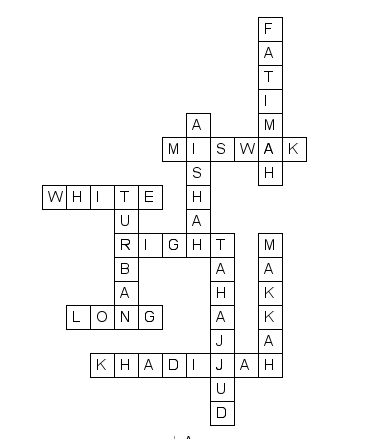
Crossword 3: Rasulullah salallahu alayhi wasallam

Assalamu Alaykum,

I have made another crossword for you to do in your free time! Here is the third of our puzzle games. It is very easy and you can also benefit by learning new things perhaps. Answers are at the bottom, no peeping!

Note: Do not use a marker on your computer screen!!


Wednesday, 20 April 2011

Commentary on Hadith: How Rasulullah salallahu alayhi wasallam received revelation - part 2

Following on from the first post which can be viewed here, we continue with the commentary of the third hadith of Bukhari sharif which describes the manner in which Rasulullah salallahu alayhi wasallam received Revelation.

ثم حُبِّبَ إِلَيْهِ الخَلاَءُ ، وَكَانَ يَخْلُو بِغَارِ حِرَاءٍ فَيَتَحَنَّثُ فِيهِ - وَهُوَ التَّعَبُّدُ - اللَّيَالِيَ ذَوَاتِ العَدَدِ قَبْلَ أَنْ يَنْزِعَ إِلَى أَهْلِهِ، وَيَتَزَوَّدُ لِذَلِكَ، ثُمَّ يَرْجِعُ إِلَى خَدِيجَةَ فَيَتَزَوَّدُ لِمِثْلِهَا، حَتَّى جَاءَهُ الحَقُّ وَهُوَ فِي غَارِ حِرَاء
“Then seclusion was made dear to Rasulullah salallahu alayhi wasallam. He would remain in solitude in the cave of Mount Hiraa where he would worship (Allah Ta’ala) for a number of nights before returning to his family. He would take provision for this stay and then (when it would finish) he would return to Khadija radiallahu anha who would make restock his supplies. This happened until the Truth (revelation) came to him whilst he was in the cave of Mount Hiraa.”


“Then seclusion was made dear to Rasulullah salallahu alayhi wasallam. He would remain in solitude in the cave of Mount Hiraa...” – The people of Makkah were living in an incredibly poor and immoral way; there were many wrongs in the society which led to various people being oppressed. The Arabs of the time held great pride in their male progeny and they would consider their male children to be their heir. If a female was born, they would kill her by burying her alive. Females were considered to be inferior and they had no worth in society. There was much prejudice against other races and society was such that the rich were oppressing the poor. In the midst of all of this, the Ka’bah was surrounded with idol gods; the people had diverted away from the religion of Ibrahim alayhis salam and they opted to worship idols once again. There was no sense of humanity within these people and the situation became increasingly worrying.

Hazrat Miqdad ibnul Aswad radiallahu anhu comments on the situation of the people at the time, “I swear by Allah, that Allah sent the Messenger of Allah salallahu alayhi wasallam as Prophet during a time that was more difficult than any other time in which Allah had sent Ambiya (prophets). It was a time when the succession of Ambiya had long been paused and when people were steeped in ignorance. People saw no religion better than idol worship. Rasulullah (May Peace and Blessings be Upon Him) arrived with a standard (the Qur’an) that differentiated between truth and falsehood...”

It is important to remember at this juncture that whilst Rasulullah salallahu alayhi wasallam was going to the cave of Hiraa he was not a prophet. Prophethood was to come to him soon as we will discuss in coming posts inshallah.

It was due to the poor state of society that Rasulullah salallahu alayhi wasallam would go to Mount Hiraa. He would spend his time in solitude and Hazrat Maulana Saleemullah Khan sahib (DB) speaks of the virtues of solitude and seclusion. He says;

“There are many benefits of seclusion;
• A persons heart becomes free
• A person finds ease in remembering things
• A person is able to stay away from evils.
• By sitting in seclusion, peace and tranquillity descends into the heart of a person. When a person is alone, he realises his entire reality.
• A person is cut off from those things which he naturally loves and desires.” (Kashful Bari)

Another reason why seclusion was made beloved to Rasulullah salallahu alayhi wasallam was due to the fact that Revelation (wahi) was soon to be bestowed upon him. His heart and his mind needed to be free in order for the weight of Revelation to be placed upon Rasulullah salallahu alayhi wasallam, he needed to be mentally and physically relaxed and at peace.

A question now arises that why did Rasulullah salallahu alayhi wasallam choose Mount Hiraa for seclusion?

In relation to the above question, Ibn Abi Jamrah rahimahullah gives a very nice answer. He says, “Rasulullah salallahu alayhi wasallam chose Mount Hiraa for seclusion because the Ka’bah could be seen from that mountain. As a result, Rasulullah salallahu alayhi wasallam would be doing three types of worship: 1) seclusion 2) his normal worship 3) visiting the house of Allah Ta’ala (Ka’bah).”

Allama Aynee rahimahullah also gives a very weighty answer. He says, “To adopt seclusion was from the shari’ah (law) of Ibrahim alayhis salam. This means that Rasulullah salallahu alayhi wasallam was following some of the rulings of Ibrahim alayhis salam which were still unaltered (by the society). And before Rasulullah salallahu alayhi wasallam, his grandfather would also visit this mountain and remain in seclusion therein. Thus when Rasulullah salallahu alayhi wasallam came of age, he also went to the same place and adopted solitude. As a result, Rasulullah’s salallahu alayhi wasallam tribesmen and uncles had no objection to him going to this place as they all had respect for him.”

When would Rasulullah salallahu alayhi wasallam go to Mount Hiraa?

Ishaaq rahimahullah mentions that Rasulullah salallahu alayhi wasallam would go there during the month of Ramadhan. In the narration of Muslim sharif it is mentioned that he would perform jawaar (stay there) there. Jawaar is basically the same as I’tikaf and Hafiz ibn Abdil Barr rahimahullah mentions that the only difference between the two is that I’tikaf is performed in a masjid and Jawaar is done in the same manner but in a place other than a masjid.
Just on a side note, Mount Hiraa is approximately three miles from Makkah on the way to Mina on the right.

“...where he would worship (Allah Ta’ala)...” – A question now arises that what type of worship is this? This was prior to any form of salah so what type of worship was Rasulullah salallahu alayhi wasallam doing?

There are four opinions with regards to this matter; 1) He was feeding the poor who would be passing by. 2) He was staying in seclusion away from the evils. 3) He was contemplating. 4) Hazrat Aishah radiallahu anha has kept this general. From among these opinions, the third is the weightiest. However a question does arise that did Rasulullah salallahu alayhi wasallam follow the worship of the prophets who came before him?

Did Rasulullah salallahu alayhi wasallam follow the worship of the prophets who came before him?

The majority of the scholars are against this notion however but some scholars such as Ibn Hajib rahimahullah etc are of the opinion that he did. If the latter opinion is taken then the question arises that which prophet did he follow? There are several possible answers; 1) Adam alayhis salam as has been mentioned by ibn Burhan rahimahullah. 2) Nuh alayhis salam as has been related by Al Aadimee rahimahulullah. 3) Ibrahim alayhis salam which a whole group of scholars have favoured. 4) Musa alayhis salam. 5) Eesa alayhis salam. 6) Rasulullah salallahu alayhi wasallam would do all those things which were practised by the prophets before him. 7) There is no specifying and thus we remain silent.

If we accept that Rasulullah salallahu alayhi wasallam followed one of the prophets before him then out of all the opinions mentioned above, the third opinion is the strongest.

“...for a number of nights before returning to his family.” – What is meant by a number of nights? Allamah Teebi rahimahullah mentions that a small number of nights is intended but the likes of Allamah Kirmani and Allamah ibn Abi Jamrah rahimahumullah have said that a number of nights means many nights.

He would return to his wife Khadija radiallahu anha when his heart would yearn for his family and wife Khadija radiallahu anha. The word in the hadith used for return is ‘يَنْزِعَ’ and this means to yearn and be enthusiastic in returning. The point being made here is that Rasulullah salallahu alayhi wasallam would continue to worship and stay in seclusion in Mount Hiraa until he would begin to miss and desire his family. When this would happen, he would then return. This also proves that there is no such thing as being a monk in Islam. A person is entitled to be in solitude and peace but here we find that Rasulullah salallahu alayhi wasallam would still come home to his family.

"He would take provision for this stay and then (when it would finish) he would return to Khadija radiallahu anha who would make restock his supplies.” – From this statement we can see that Rasulullah salallahu alayhi wasallam would make preparation for his stay in the mountain. Some Ulama are of the opinion that this was a porridge type of food. He would make use of the things he had available to him. Many people make no preparation and then say ‘we place our trust in Allah Ta’ala!” but this is not correct. In one hadith in Tirmidhi Sharif, we find a sahabi who came inside the masjid for prayer but failed to tie his camel. When he was asked about his camel, he said that he places his trust in Allah Ta’ala that Allah Ta’ala will keep it secure. Upon this Rasulullah salallahu alayhi wasallam said, “Tie it up (secure it) and then place your trust in Allah Ta’ala.”

“This happened until the Truth (revelation) came to him whilst he was in the cave of Mount Hiraa.” – Rasulullah salallahu alayhi wasallam continued to live in this manner until the Truth came to him.

What is meant by ‘the Truth’?

Allamah Teebi rahimahullah mentions that Revelation (wahi) is meant by ‘the Truth’ or “The Messenger of the Truth’. By the ‘Messenger of Truth’ Hazrat Jibraeel alayhis salam is intended.

Inshallah in the next post we will discuss how the first words of the Revelation (Qur’an) were bestowed upon Rasulullah salallahu alayhi wasallam and his reaction to it.


May Allah Ta’ala accept our efforts. Ameen.

Friday, 11 March 2011

Event: Dars of Shama'il Tirmidhi - A Lesson on the ahadith which describe the attribute of Rasulullah salallahu alayhi wa salam


Dars of Sham'ail at Tirmidhi
A Lesson on 1 Chapters from Shama'il Tirmidhi

With Sheikh Irfan Sidyot
(Principal & Senior Lecturer of Hadith, Jamia Siraj ul Uloom)

Saturday 2nd April 2011
10am - 4pm
London Metropolitan University
Calcutta House,
Old Castle Street,
London, E1 7NT

Closest Tube: Aldgate East


1)Chapter on the speech of Rasulullah salallahu alayhi wa sallam
2)Chapter on the laugh of Rasulullah salallahu alayhi wa sallam
3)Chapter on the story telling of Rasulullah salallahu alayhi wa sallam at night
4)Chapter on the worship and devotion of rasulullah salallahu alayhi wa sallam
5)Chapter on the modesty of Rasulullah salallahu alayhi wa sallam
6)Chapter on the seeing of Rasulullah salallahu alayhi wa sallam in a dream
7)Chapter on the noble features of Rasulullah salallahu alayhi wa sallam
8)Chapter on the noble character and habits of Rasulullah salallahu alayhi wa sallam
9)Chapter on the weeping of Rasulullah salallahu alayhi wa sallam
10)Chapter on Rasulullah salallahu alayhi wa sallam using 'itr

ourse material and light refreshments will be provided. Tickets can be purchased through the Islamic Society."This event is open to all. However people entering the university externally must register their tickets with the ISOC by e-mailing calcuttabros@googlemail.com


Tickets cost only £5 so please book early to avoid disappointment!

Tuesday, 25 January 2011

Commentary on Hadith: How Rasulullah salallahu alayhi wa salam received revelation - part 1

The following is a commentary I have compiled by using Fathul Baari and Kashful Baari in relation to the third hadith or Bukhari Sharif which deals with the manner in which Rasulullah salallahu alayhi wa salam received revelation from Allah Ta'ala. There are many narrations which describe this matter but I felt that this hadith is amazing as it takes a person back to the very beginning of Rasulullah's salallahu alayhi wa salam prophethood. The hadith in itself is quite long but I have decided to break it up bit by bit in order to give a somewhat detailed but succinct commentary of it. Inshallah, I intend to continue to write more of the hadith with its commentary as time progresses. I have begun first by mentioning extremely brief notes on the people who have narrated this hadith.

حدثنا يحيى بن بكير قال: حدثنا الليث عن عقيل، عن ابن شهاب، عن عروة بن الزبير، عن عائشة أم المؤمنين أنها قالت: أول ما بدىء به رسول الله صلى الله عليه وسلم من الوحي الرؤيا الصالحة في النوم، فكان لا يرى رؤيا إلا جاءت مثل فلق الصبح
Yahya ibn Bukayr narrates to us, he says: Layth has narrated to us on the authority of Uqayl from Ibn Shihaab from Urwah ibn Zubair from Aishah the Mother of theBelievers radiallahu anhum that she said “The first thing by which Rasulullah salallahu alayhi wa salam would receive revelation would be through good dreams. He would never see any dream except that it would become as clear as daylight (i.e. it would occur).”

Yahya ibn Bukayr – His full name is Abu Zakariyyah Yahya ibn Abdullah ibn Bukayr al Qurashee al Makzhoomi al Misri. Some have said he is from Egypt, Imam Bukhari rahimahullah is of the opinion he was from Syria (Tareekhul Kabeer).

Layth – His full name is Abul Harith Layth ibn Sa’d ibn Abdur Rahman Fahmi. He was from Qalqashandah or Qarqashanda which is close to Egypt. He was born in 94 AH. He was a great scholar and Imam Shafi rahimahullah says about him, “He was more learned than even Imam Malik but his students did not spread his works (by which he would be recognised further).”
Uqayl – His full name is Uqayl ibn Khalid ibn Aqeel. He was a trustworthy narration of hadith. He passed away in Egypt in the year 144AH.

Ibn Shihaab – His full name is Abu Bakr Muhammad ibn Muslim ibn Ubaydullah ibn Abdullah ibn Shihaab ibn Abdullah ibn al Haarith ibn Zuhrah ibn Kilaab ibn Murrah ibn Ka’ab ibn Lu’ee az Zuhri al Madani. He is more famously known by the name Ibn Shihaab az Zuhri. He is from the Tabi’een and his virtues are numerous. He was born in 50AH and passed away in 124AH.

Urwah ibn Zubair – He was the son of the great sahabi Zubair radiallahu anhu and Asma bint Abu Bakr radiallahu anhu. He was the only one from amongst his brothers who was a tabi’ee and not a sahabi.

Aishah, The Mother of the Believers radiallahu anha – She was the daughter of Abu Bakr radiallahu anhu and the most beloved wife of Rasulullah salallahu alayhi wa salam.

Now moving on to the hadith at hand, Aishah radiallahu anha mentions, “The first thing by which Rasulullah salallahu alayhi wa salam would receive revelation would be through good dreams."

The dreams Rasulullah salallahu alayhi wa salam saw were there in order to ready him for Prophethood and the Qur'an which was to be revealed to him soon. As a result of these dreams, Rasulullah salallahu alayhi wa salam would know that something extra ordinary is occurring and thus, the coming of Jibraeel alayhis salam in Mount Hiraa would not be such a massive shock. Many things besides true dreams occurred prior to Rasulullah salallahu alayhi wa salam embracing prophethood. In some narrations related by Imam Bayhaqi it is mentioned that Rasulullah salallahu alayhi wa salam would be walking in Makkah and he would hear somebody greeting him with ‘salaam’ He would turn around and except stones and trees, there was nothing else there. Another narration in Muslim Sharif mention, “I recognise the stone that would greet me in Makkah before my prophethood. I can still recognise it even now.”

The point made here is that Rasulullah salallahu alayhi wa salam was being prepared for the prophethood which was to come his way. The example of this is perhaps like a job. A person will not be thrown into the middle of the work floor straight away and be expected to deal with customers instantly but rather, he will be given some brief training and indications as to what he should be doing so that he will not get a shock when he is in on duty. Over here, we have Rasulullah salallahu alayhi wa salam, who was coming to the age of 40; this is the age in which prophets are given their prophethood. Soon Rasulullah salallahu alayhi wa salam would have the words of the Qur’an revealed to him by an angel in the darkness of Mount Hiraa; for this to happen straight away with no warning would leave a person stunned and thus Rasulullah salallahu alayhi wa salam was the recipient of some extra ordinary occurrences which in turn would make him aware that something remarkable is on its way. It is for this reason Rasulullah salallahu alayhi wa salam would be shown good dreams and would be given greetings by inanimate objects.

A Good Dream

In two different places in Bukhari Sharif (Kitab at Tafseer, Kitab at Ta’beer) The word ‘salihah (good)’ has been substituted for the word ‘saadiqah (true)’. In fact, the dreams of Rasulullah salallahu alayhi wa salam were of three types: 1) Salihah (good) 2) Saadiqah (true) 3) Waazihah (clear).

The meaning of number 3 (waazihah) is this that when Rasulullah salallahu alayhi wa salam would have a dream it would be clear in its meaning without any ambiguity. It was completely clear and explicit in its meaning and there would be no difficult in recalling it.

In relation to number 1 & 2, the Ulama have mentioned that the true dream (saadiqah) is more general than the good dream (saalihah). This is because the dreams of all the prophets are true but not every dream would be a good dream. For example, in Bukhari Sharif it is mentioned Rasulullah salallahu alayhi wa salam had a dream during the period of the battle of Uhud in which he saw himself making movements with a sword but that sword would break and likewise he would see that a cow was being sacrificed. Rasulullah salallahu alayhi wa salam then gave the interpretation that both dreams meant the death and martyrdom of some of the Sahabah radiallahu anhum. Now, the dream in itself was a true dream which did occur but it is obvious, to see the Sahabah radiallahu anhum in such pain is not a good and happy dream. Thus it is established that a dream can be of a true nature but at the same time it can also be good or bad.
Imam Bayhaqi rahimahullah mentions that these dreams were continuous for the period of 6 months.

He would never see any dream except that it would become as clear as daylight (i.e. it would occur).”

The word ‘falaq’ فلق used in this hadith literally means to split, rip or tear something. For example, in the Qur’an it comes that “Verily, Allah is the One who splits seeds...” (Surah An’aam)

However the word in this hadith فلق الصبح which I have translated as ‘daylight’ is used in order to explain the clarity by which Rasulullah salallahu alayhi wa salam would see his dreams. There would be no ambiguity, vagueness or confusion in them. The opposite to ‘daylight’ is darkness and during this time, it is hard to see anyone. Many people think that they have seen something but this is with much doubt and there is no such certainty about it. On the contrary, when something is seen in daylight, a person is certain that his eyes have not deceived him. This is what is being mentioned in this hadith that whatever Rasulullah salallahu alayhi wa salam saw in his dream, its meaning was apparent. It was for this reason that the Sahabah radiallahu anhum mention that they would abstain from waking Rasulullah salallahu alayhi wa salam up in his sleep because it may be the case that Rasulullah salallahu alayhi wa salam was receiving revelation.

Hazrat Maulana Saleemullah Khan sahib has given an excellent opinion as to what is mentioned by this entire statement of Aishah radiallahu anha. He says that this entire statement is in line with the way prophethood had come to Rasulullah salallahu alayhi wa salam and it is shown by the example of the sun rising in the morning to produce clear daylight. In the beginning there was total darkness but the rays of the sun were beginning to be seen and this is similar to the prophethood that the stones and trees were saying “Peace be upon you O Messenger of Allah” but the revelation was soon to come. Then the light of the sun became increased in its visibility and in the same way, the dreams of Rasulullah became extremely clear and positive. Then when the sun actually rises to its fullest, Muhammad alayhis salatu was salam will also emerge as the clear Prophet of Allah Ta’ala. It is for this reason Allah Ta’ala calls Rasulullah salallahu alayhi wa salam ‘Assiraajum Muneera’ A bright, guiding light which is similar to daylight.

Sunday, 12 December 2010

The Greatness of Rasulullah salallahu alayhi wa salam

Note: The following is a transcript of a bayaan given by one of our authors when a group of misinformed people began to draw sketches of Rasulullah salallahu alayhi wa salam on Facebook etc.

In recent times, we have seen many people attempt to ridicule Rasulullah salallahu alayhi wa salam in many ways. The recent attempts that we have seen in relation to Facebook is only another endeavour to tarnish the blessed name of Muhammad salallahu alayhi wa salam. A name which can never be tarnished for as long as the tongues of mankind continue to sound and the pens of mankind continue to etch his praise.

The reason that these efforts have been made is due to a lack of understanding with regards to whom Rasulullah salallahu alayhi wa salam is. This ignorance is not just prominent within the non Muslims but it has seeped its way into the Muslims today. Many of our hearts today are still asleep in relation to the conduct and character of Rasulullah salallahu alayhi wa salam. The reason that his love has not penetrated our hearts is due to our negligence in learning about him. The more we learn about Rasulullah salallahu alayhi wa salam, the more our hearts will be filled with admiration, awe, love and affection for him. The abuse that has been targeted to him in recent times is not something new but rather this is something old and ancient. Rasulullah salallahu alayhi wa salam was made to suffer abuse much worse than what we see today. The people of his time would label him as being insane and this was so disliked in the eyes of Allah Ta’ala that Allah Ta’ala made radd and refuted these people and their like till the day of Qiyamah, He says in the Qur’an

نٓ‌ۚ وَٱلۡقَلَمِ وَمَا يَسۡطُرُونَ مَآ أَنتَ بِنِعۡمَةِ رَبِّكَ بِمَجۡنُونٍ۬ وَإِنَّ لَكَ لَأَجۡرًا غَيۡرَ مَمۡنُونٍ۬ وَإِنَّكَ لَعَلَىٰ خُلُقٍ عَظِيمٍ۬
“Nūn. By the pen and what people note down. By the favours of your Lord, You are not a mad man or insane as (people claim). Surely you will get your reward that will never cease, (your rewards is endless which has no limits). Surely, you are of sublime character.”

People will come and they have been coming from the beginning of Rasulullah’s salallahu alayhi wa salam prophethood and these people will continue to come. They will slander and speak falsely about Rasulullah salallahu alayhi wa salam but their words will be like the ashes in the wind. When the wind blows, there words too will be blown and nobody will remember what they had to say. But the Qur’an is the Book of Allah Ta’ala and this means that it is the Word of Allah Ta’ala. And this Word will remain and continue to exist right up to the final hour and until then the statement will remain for the entirety of mankind that

وَإِنَّكَ لَعَلَىٰ خُلُقٍ عَظِيمٍ۬
Surely, you are of sublime character.

When it came towards caring and loving those people who were around him, then no person can match Rasulullah salallahu alayhi wa salam with regards to the care and love he showed his ashaab radiallahu anhum. He once said in a hadith,

وأنا أمنة لأصحابى
I am a source of safety for my companions.

The attention and care he would show these blessed souls was unimaginable. He would give time and love to everybody and would not make anybody feel out of place. Hazrat Amr ibn al Aas radiallahu anhu narrates,

كان رسول الله صلى الله عليه و سلّم يُقبِلُ بوجهِهِ و حديثهِ على اشرِّ القوم
Rasulullah salallahu alayhi wasalam gave attention, spoke and showed love to the worst person of a nation. So that, the person may feel he is being given special attention.

The love he would give to people in general would be unimaginable. Today, we cannot even give time to our family members or to our spouses and Rasulullah salallahu alayhi wa salam was such a man, that whomsoever would meet him would feel accepted straight away. Today, we only like to speak to those people whom we feel are on the same wavelength as us or on the same level of piety. This is incorrect, Rasulullah salallahu alayhi wa salam was such that in the hadith it comes,

و يجيب دعوة مملوك
“He would accept the inivitation of a slave.”

A servant or slave would have only had a few pennies and so if he invited people for food, what would he cook? But Rasulullah salallahu alayhi wa salam would not refuse, he would go and accept the invitation of a slave aswell and like his, he would care for everyone.

When it came to bringing an aura of happiness and cheerfulness to the people. He would always be smiling and would be cheerful. Abdullah ibn Haarith says,

ما رايت احدا اكثر تبسُّماً من رسول الله صلى الله عليه و سلّم
“I did not see anyone smile more than Rasulullah salallahu alayhi wa salam.”

Hazrat Aishah radiallahu anha says,

لم يكن رسول الله صلى الله عليه و سلّم فاحشا و لا متفحّشا و لا صخّابا فى الاسواق و لا يجزى بالسيئة السيّئة و لكن يعفو و يصفح ،
“Rasulullah was not foul mouthed, nor would he pretend to be foul mouthed, nor would he shout loudly in the market, nor would he repay evil with evil, however, he would pardon and overlook”

Today, we are the opposite. Our tongues have become so foul that every sentence we utter contians swear words. We use our tongues to break of relations and be so rude to people who are not deserved of it. Rasulullah salallahu alayhi wa salam would never shout loudly in the market. In those regards, he would never shout out and cause attention to come his way unecessarily. There are some people who have loud tendencies, whenever you see them they are shouting and hollering.

He would never shout loudly, nor would he rebuke people, he would never be rude or vulgar. He would always forgive people and would always overlook their mistakes. Today we catch people on their every fault and mistake. Sometimes we hold bitter rivalries with people because of the most silliest reasons. Over secrets which have been kept and over small things.

He always showed extreme modesty, he would never stretch his legs facing someone in a gathering. When he would arrive in a gathering, he would sit wherever there was an empty space. He would not look for the best spot nor would he make someone get up from their place in order to take theirs. Today we are the opposite, whenever we come into a gathering, we want to make sure people stand up for us and that they give us their seat!

He would look down most of the time and would never stare at the skies. He was cheerful, always smiling, even though he might be hiding many agonies. The muhaditheen mention that he would be in a constant state of worry out of fear of what will happen to his ummah in the akhirah but he would always put on a smile in order to bring comfort to the people around him. Sometimes people need to be optimistic and happy in order to keep the people around them in the same manner.
He had a beautiful fragrance that would emit naturally from his body. Sayyidina Abu Ya’laa radiyallahu anhu and others relate that in whichever alley Sayyidina Rasulullah sallallahu alaihe wasallam passed, others who passed later knew immediately that Sayyidina Rasulullah sallallahu alaihe wasallam had just passed there. Once Sayyidina Rasulullah salallahu alayhi wasalam blew (made damm) on his palm and wiped it over the back and stomach of Sayyidina Uqbah radiyallahu anhu. It became so fragrant, and as he had four wives, every one of them put on so much itr, to equal that fragrance, but it could not overcome the fragrance Uqbah radiyallahu anhu had.
When it came to his humility, it is recognised that there is nobody more humble than he is. When he would walk, he would swiftly walk from one place to another. The sahabah radiallahu anhum relate how they sometimes would find it difficult to keep pace with him. He would be in once place at one time and then move very quickly. And during this walk, he would always maintain humility. He would never walk in a manner which showed boasting. Allah Ta’ala says in the Qur’an,

وَلَا تَمۡشِ فِى ٱلۡأَرۡضِ مَرَحًا‌ۖ إِنَّ ٱللَّهَ لَا يُحِبُّ كُلَّ مُخۡتَالٍ۬ فَخُورٍ
Do not walk on the earth with conceit, verily Allah does not love any self conceited boaster.

His humility was such that he would not be bothered with the material wealth of the world, he would be satisfied with what he had and would not try and force the issue of wealth. From amongst his dua’s would be,

اللهم قنعني بما رزقتني
O Allah, make me content on what you have provided for me.

His behaviour was such that once, Umar radiallahu anhu entered the house of Rasulullah salallahu alayhi wa salam. And he saw that Rasulullah salallahu alayhi wa salam was sleeping on the floor upon a mat made out of reed. Try it out some day, you will find a mat of this nature will scar your body and cause you pain... Rasulullah salallahu alayhi wa salam is lying on this mat... Umar radiallahu anhu sees the state of Rasulullah salallahu alayhi wa salam and

فبكى عمر
Umar began to cry

ما يبكيك يا عمر؟
What makes you cry O Umar?

والله! ما ابكى الاّ اكون اعلم أنّك أكرم على الله من كسرى و قيصر ، و هما يعيشان في الدنيا فيما يعشان فيه ، و انت يا رسول الله فى المكان الذي أرى!
I swear by Allah! I do not cry except that because I know that you are more exalted in the sight of Allah then the emperor of Persia and the Caesar of Rome. And they are both are at ease in the world and you, O Rasulullah are in this state that I am seeing you in.
What was the response of Rasulullah salallahu alayhi wa salam?

ما لي و للدنيا؟
What is with me and the world?...

Today we find that people are running around after this world. I am not saying abandon it, that is incorrect. Take what you need and live but it is completely absurd that a person would want to spend £600 on a pair of jeans or £500 for his police man goggles. Rasulullah salallahu alayhi wa salam was extremely simple in the manner he lived.

When it came to his relationship with Allah Ta’ala. His fear, reliance, trust in Allah Ta’ala was unparalleled. As for his fear of Allah Ta’ala, he would say “O Allah! Make Your love the most beloved of all things to me, and make Your fear and reverence the most fearful thing in my mind.” Sometimes during his night prayers, he would weep so bitterly that his chest would sound like a boiling kettle.

Today, we cannot even cry, our hearts have become so hard that we find it hard to cry.
As for his reliance, we recall the episode of Ta’if... The situation was such that he had been calling the people of Makkah to Islam but only some would listen. When it seemed that they would not listen anymore, Rasulullah salallahu alayhi wa salam went to Ta’if where again he called people towards Islam.

For ten days he stayed there delivering his message to several people, one after another, but all to no purpose. The people of the Taif did not like this message, the people rushed him through the alley-ways, pelted him with stones and forced him to flee from the city pursued by a relentless mob all hurting him. Blood flowed down both his legs; his slippers were stuck to his Mubarak feet...such was the pain he had to suffer. The mob did not desist until they had chased him two or three miles across the sandy plains to the foot of the surrounding hills. There, wearied and exhausted, he took refuge in one of the numerous orchards, and rested against the wall of a vineyard.

At a time when the whole world seemed to have turned against him, Muhammad salallahu alayhi wa salam. He salallahu alayhi wa salam turned to his Lord and beseeched him. He is the messenger of Allah and he would have been justified if he had asked Allah Ta’ala to destroy these people yet look at the dua’a he prays...

“O Allah! To You do I relate the weakness of my strength, and lack of my planning and my low status in the eyes of people, O the Most Merciful from amongst those who are merciful! You are the Lord of those who are weakened, You are my Lord - to whom do You hand me over? To someone distant? One who will attack me? Or to some enemy in whose hands You have put my affairs? But if Your wrath does not fall on me, there is nothing for me to worry about., however, Your ‘aafiyat (security) is more encompassing for me. I seek refuge of the nur of Thy countenance with which all darkness lightens up, and upon which depends the matters of the world and the Hereafter. May it never be that I should incur Your wrath, or that You should be wrathful to me. It is Your right that forgiveness is sought from You until You are pleased. There is neither power to turn away from evil nor any strength to do good except with Your tawfiq.”

The effect of this powerful dua’a was such that Allah Ta’ala immediately sent an angel to the mountains which surrounded Taif. The angel asked Rasulullah salallahu alayhi wa salam for permission to crush Taif between these two mountains but even then, Rasulullah salallahu alayhi wa salam said,

بل ارجو أن يخرجَ من اصلابهم يعبدُاللهَ وحدَه لا يُشرِكُ به شئا
“No, rather I hope that such people will come from their offspring who worship Allah and do not associate partners to him.”

It is for this reason Allah Ta’ala has said in the Qur’an

لَّقَدۡ كَانَ لَكُمۡ فِى رَسُولِ ٱللَّهِ أُسۡوَةٌ حَسَنَةٌ۬ لِّمَن كَانَ يَرۡجُواْ ٱللَّهَ وَٱلۡيَوۡمَ ٱلۡأَخِرَ وَذَكَرَ ٱللَّهَ كَثِيرً۬ا
“There is indeed a good model for you in the Messenger of Allah - for the one who has hope in Allah and the Last Day, and remembers Allah profusely.”

If we were to adapt to his lifestyle, and inculcate the same qualities within us, we would also become beloved to Allah . It is important for us to hold on to the outward and inward characteristics of Rasulullah salallahu alayhi wa salam. If we do not follow his sunnah in following him and changing our appearance to look like him, who will?